


+86 20 84133345
+1 781 218 9688

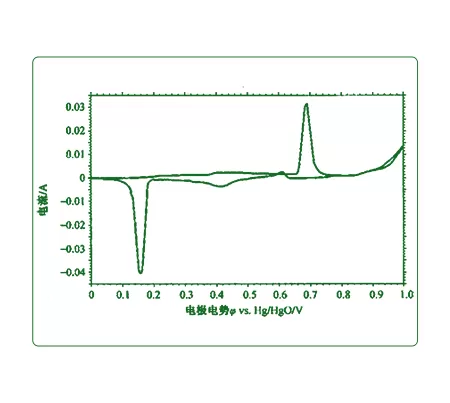 Cyclic Voltammetry to Test Electrochemical Reactions of Metals in Solution
Cyclic voltammetry refers to controlling the potential under study to scan from the initial potential to the reverse potential at a constant speed, changing the scanning direction, scanning back to the initial potential at the same speed, and continuing to reverse the potential, repeatedly scanning, and recording the current-potential The curves are called cyclic voltammetry lines.
Cyclic Voltammetry to Test Electrochemical Reactions of Metals in Solution
Cyclic voltammetry refers to controlling the potential under study to scan from the initial potential to the reverse potential at a constant speed, changing the scanning direction, scanning back to the initial potential at the same speed, and continuing to reverse the potential, repeatedly scanning, and recording the current-potential The curves are called cyclic voltammetry lines.
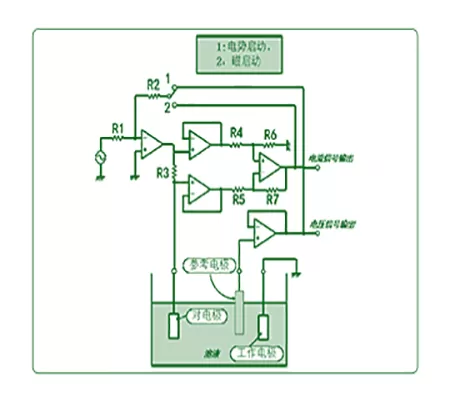 Application in the Determination of Chemical Resistance
To measure the chemical impedance at complex frequencies, a frequency response analyzer, known as the digital version of the lock-in amplifier, is used to make the frequency sweep easier to use.
Application in the Determination of Chemical Resistance
To measure the chemical impedance at complex frequencies, a frequency response analyzer, known as the digital version of the lock-in amplifier, is used to make the frequency sweep easier to use.
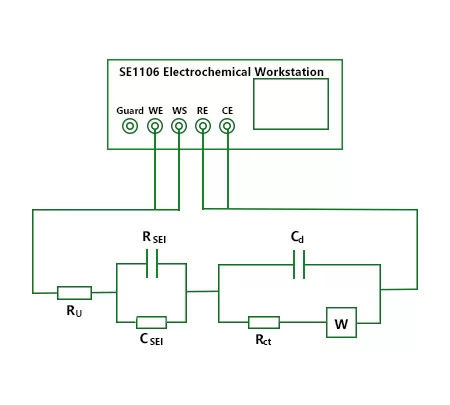 Constant Current Charge/Discharge Method Test
Constant current charging and discharging method, also known as timing potential method. Its basic working principle is to charge and discharge the tested electrode under constant current conditions, record the change rule of its potential with time, and then study the electrode's charging and discharging performance and calculate its actual specific capacity.
Constant Current Charge/Discharge Method Test
Constant current charging and discharging method, also known as timing potential method. Its basic working principle is to charge and discharge the tested electrode under constant current conditions, record the change rule of its potential with time, and then study the electrode's charging and discharging performance and calculate its actual specific capacity.
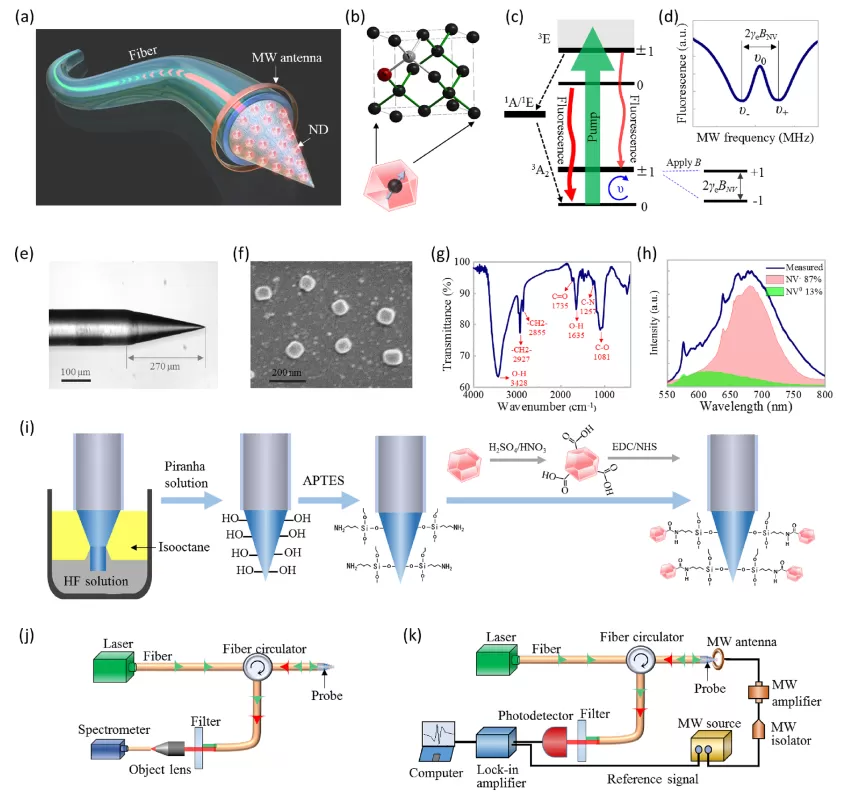 OE1022D Applied to Fiber Optic Quantum Probe Applications
Recently, Prof. Luo Yunhan and Prof. Chen Yaofei from School of Science and Technology, Jinan University published a paper titled "Nanodiamond-Based Optical-Fiber Quantum Probe for Magnetic Field and Biological Sensing" in ACS Sensors, an authoritative international chemistry journal.
OE1022D Applied to Fiber Optic Quantum Probe Applications
Recently, Prof. Luo Yunhan and Prof. Chen Yaofei from School of Science and Technology, Jinan University published a paper titled "Nanodiamond-Based Optical-Fiber Quantum Probe for Magnetic Field and Biological Sensing" in ACS Sensors, an authoritative international chemistry journal.
 OE1022 in The Study of Quantum Temperature Sensors for Nitrogen Vacancy (NV) in Diamond
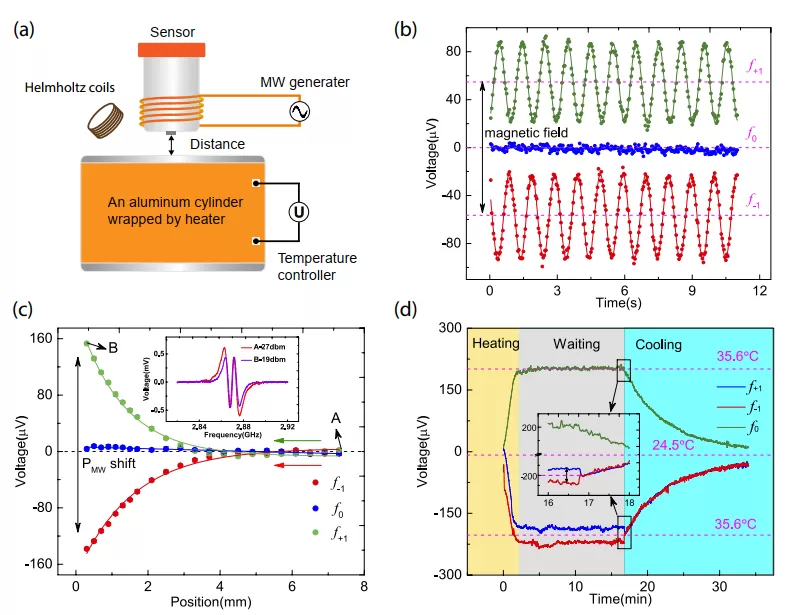
In 2021, academician Guo Guangcan's team at the University of Science and Technology of China & Key Laboratory of Quantum Information, Chinese Academy of Sciences (KLQIS) published an article in Review of scientific instruments titled "A robust fiber-based quantum thermometer coupled with nitrogen-vacancy centers", reporting a quantum temperature sensor based on nitrogen-vacancy (NV) centers in diamond.
OE1022 in The Study of Quantum Temperature Sensors for Nitrogen Vacancy (NV) in Diamond
In 2021, academician Guo Guangcan's team at the University of Science and Technology of China & Key Laboratory of Quantum Information, Chinese Academy of Sciences (KLQIS) published an article in Review of scientific instruments titled "A robust fiber-based quantum thermometer coupled with nitrogen-vacancy centers", reporting a quantum temperature sensor based on nitrogen-vacancy (NV) centers in diamond.
 Electron Paramagnetic Resonance Measurement
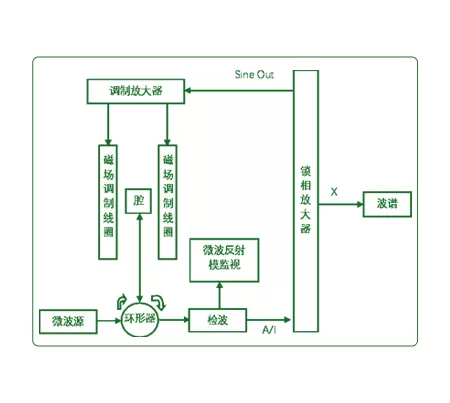
Electron paramagnetic resonance (EPR) or electron spin resonance (ESR) is one of the most informative techniques for the electronic structure of paramagnetic materials.EPR spectroscopy is particularly useful for studying chemical systems with strong local spin densities and their interactions with the environment.
Electron Paramagnetic Resonance Measurement
Electron paramagnetic resonance (EPR) or electron spin resonance (ESR) is one of the most informative techniques for the electronic structure of paramagnetic materials.EPR spectroscopy is particularly useful for studying chemical systems with strong local spin densities and their interactions with the environment.
 Hall Effect Measurement
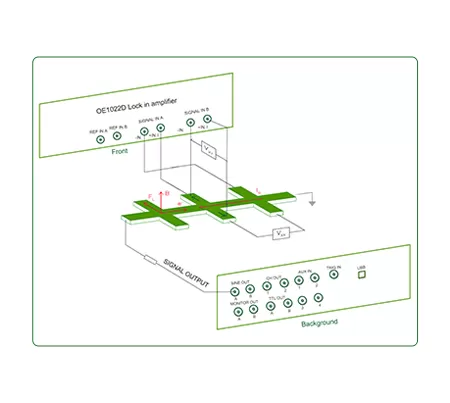
The Hall effect is a kind of electromagnetic effect. When the current passes through the semiconductor perpendicular to the external magnetic field, the carriers are deflected, and an additional electric field is generated perpendicular to the direction of the current and the magnetic field, thereby generating a potential difference between the two ends of the semiconductor. The phenomenon is the Hall effect. The Hall effect is widely used in material characterization and magnetic field sensing.
Hall Effect Measurement
The Hall effect is a kind of electromagnetic effect. When the current passes through the semiconductor perpendicular to the external magnetic field, the carriers are deflected, and an additional electric field is generated perpendicular to the direction of the current and the magnetic field, thereby generating a potential difference between the two ends of the semiconductor. The phenomenon is the Hall effect. The Hall effect is widely used in material characterization and magnetic field sensing.
 Weak Current Measurement Report for Superconducting Material by Lock-in Amplifier
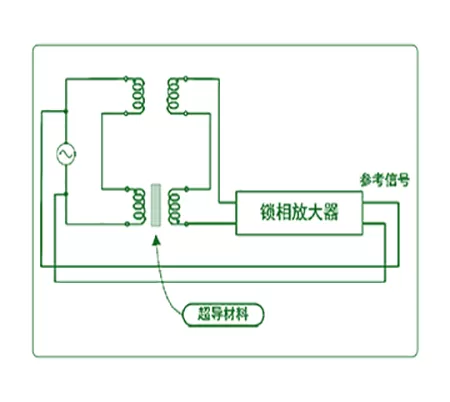
Samples of superconducting material applied by a weak alternating voltage can occur a weak current through itself, which can be measured by LIA in order to avoid the measurement error from thermoelectric EMF effect.
Weak Current Measurement Report for Superconducting Material by Lock-in Amplifier
Samples of superconducting material applied by a weak alternating voltage can occur a weak current through itself, which can be measured by LIA in order to avoid the measurement error from thermoelectric EMF effect.
 Application in Metal Material Tension Test
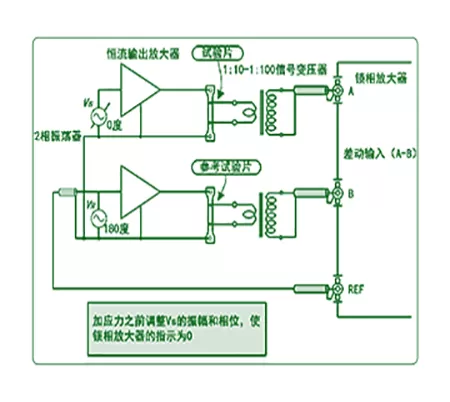
Tensile tests are to be carried out when evaluating the strength of metallic materials. In order to detect small changes in metal cracks or shape, you can measure the AC resistance of sample (called AC potential method).
Application in Metal Material Tension Test
Tensile tests are to be carried out when evaluating the strength of metallic materials. In order to detect small changes in metal cracks or shape, you can measure the AC resistance of sample (called AC potential method).
 OE1022 Applied to Scanning Tunneling Microscopy Measurements in Superconducting Thin Films
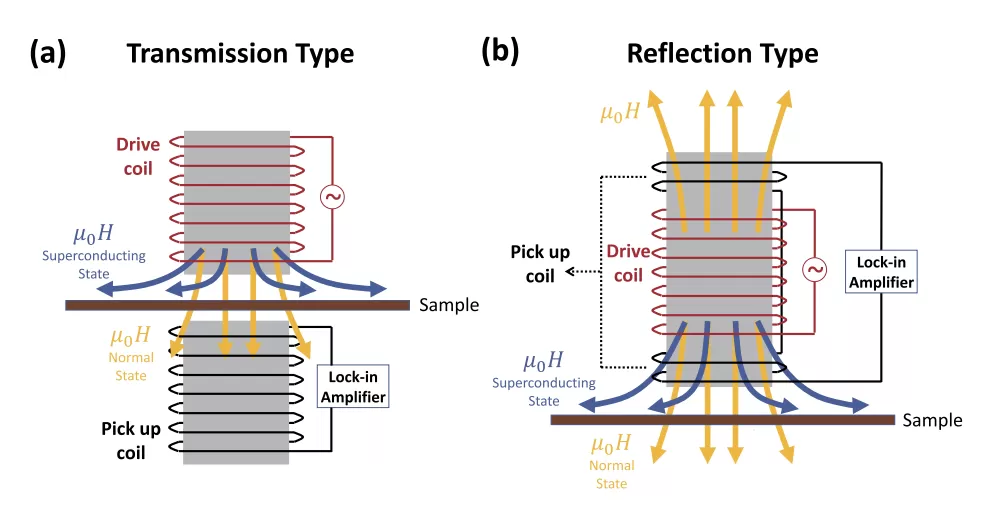
In 2017, Jinfeng Jia and Canhua Liu of Shanghai Jiaotong University published an article entitled "Development of in situ two-coil mutual inductance technique in a multifunctional scanning tunneling microscope" article, reporting the development of in situ two-coil mutual inductance technique in a multifunctional scanning tunneling microscope.
OE1022 Applied to Scanning Tunneling Microscopy Measurements in Superconducting Thin Films
In 2017, Jinfeng Jia and Canhua Liu of Shanghai Jiaotong University published an article entitled "Development of in situ two-coil mutual inductance technique in a multifunctional scanning tunneling microscope" article, reporting the development of in situ two-coil mutual inductance technique in a multifunctional scanning tunneling microscope.