| Voltage Input Mode | Single-ended or Differential |
| Full-scale sensitivity | 1 nV to 5 V in 1-2-5 sequence |
| Current gain | 10^6V/A |
| Input Impedance: | |
| Voltage | 10 MΩ//10 pF, AC or DC coupled |
| Current | 1 kΩ to virtual ground |
| C.M.R.R | >70 dB to 10 kHz,decreasing by 6 dB/oct above 10 kHz |
| Dynamic reserve | >120 dB |
| Gain accuracy | 0.5% standard,2% max. |
| Voltage noise | 5 nV√ Hz at 997 Hz |
| Inputs: | |
| Frequency range | DC to 100kHz/500kHz/1 MHz |
| Reference Input | TTL or Sine |
| Input impedance | 10 MΩ |
| Square reference level | VIH>3V, VIL<0.5V |
| Sine reference signal | >2 Hz,>400 mVpp |
| Phase: | |
| Resolution | 1udeg |
| Absolute phase error | <1deg |
| Relative phase error | <0.001deg |
| Orthogonality | |
| Internal Reference | At 1 kHz: <0.0001° rms |
| External Reference | At 1 kHz: 0.005° rms (time constant 100 ms, 12 dB/oct) |
| Drift | <0.01 deg/℃ below 10 kHz |
| <0.1 deg/℃ above 10 kHz | |
| Harmonic detection | 2F, 3F, ...nF to100/500 kHz (n<65,535) |
| Acquisition time: | |
| Internal reference | instantaneous acquisition |
| External reference | (3 cycles + 5 ms) or 40 ms, whichever is larger |
| Number of demodulators | 8 |
| Stability: | |
| Digital Output | No zero drift for all settings |
| Display | No zero drift for all settings |
| Analog Outputs | <5 ppm/℃ for all dynamic reserve settings |
| Harmonic Rejection | -90 dB |
| Time constant | 1 us to 3 ks, 6, 12, 18, 24, 30, 36, 42 ,48dB/oct rolloff |
| Synchronization Filter | Available below 1 kHz(18,24,30,36,42,48 dB/oct rolloff) |
| Frequency: | |
| Range | 1 uHz to 100kHz/500kHz/1 MHz |
| Accuracy | 2 ppm + 10 uHz |
| Resolution | 1 uHz |
| Distortion | -70 dBc |
| Amplitude: | 1 mVrms to 5 Vrms (resolution 1 mVrms) |
| Tolerance | 0.5% (f < 10 kHz), Maximum: 2% |
| Temperature stability | 100 ppm/°C |
| Sine Output | Sine signal, output impedance 50 Ω |
| TTL Synchronous Output | 5V TTL/CMOS level, output impedance 200 Ω |
| CH 1 and CH 2: | |
| Function | X, Y, R, θ and harmonics |
| Amplitude | ±10 V |
| Drive Current | ±30mA max |
| AUX Inputs: | |
| Function | 2-channel inputs |
| Amplitude | ±10 V, 1 mV resolution |
| Impedance | 1 MΩ |
| RS-232 | Standard 9-array RS-232 female socket |
| USB2.0 | USB 2.0 high speed communication interface |
| Enternet | 1 Gbps Gigabit network communication interface |
| Power Requirements: | |
| Voltage | 220-240 VAC (110~120 VAC optional) |
| Frequency | 50 Hz / 60 Hz |
| Power | 50 W to 200 W (Increase power with additional channels) |
| Power supply noise rejection | 70 dB@1 MHz |
| Scanning Microscope | AFM, STM, SPM |
| Materials Science | Carrier mobility, Carrier density, Hall effect, Ultrasonic materials |
| Transport Measurement | Conductivity measurement, lmpedance measurement |
| Noise Represents | Noise density, Cross-correlation measurement |
| Optical Experiment | Spectral analysis, Spectral measurement, THz measurement, TDLAS |
| Sensor Measuring | Gyroscope, Photoelectric sensor, Resonator, Accelerometer |
| Magnetic Sensor | SQUIDs, NV color center, Atomic Magnetometer, VSM |
| Biomedical | Microfluidic |
The oscilloscope features a 4 MSa/s analog input channel with 2 MHz analog bandwidth, 5 Vrms input voltage range, and user-configurable AC/DC coupling and 10 MΩ impedance.

Spectrum analyzers can observe DC to1 MHz input signals in the frequency domain. Simultaneous resolution bandwidths are as low as 1 Hz with a minimum span of 100 Hz.

Equipped with graphical upper computer software. With quick graphic buttons and rich graphic operation functions, in addition, the software has a clear numerical value display and waveform display function, real-time display of measurement data, measurement results can be saved in excel format output for subsequent analysis of professional software, so as to make the test easy to handle. In addition, we also fully support Python, MATLAB and LabVIEW application program interface (API).

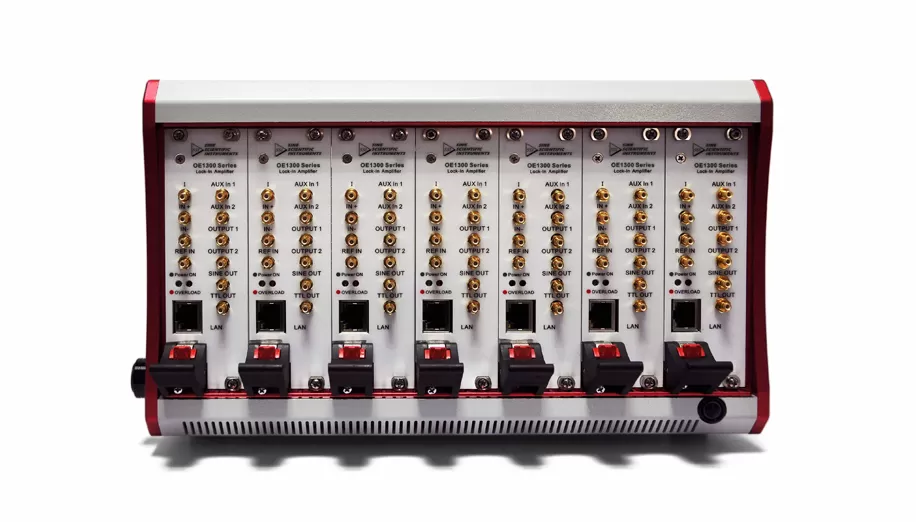
Conventional lock-in amplifiers can only measure the fundamental frequency or a certain harmonic component at the same time. Therefore, for some cases that require the amplitude and phase of multiple frequency components at the same time, traditional lock-in amplifiers are unable to meet the measurement requirements.The digital side of the multi-channel lock-in amplifier combines FPGA and ARM technology to realize higher processing bandwidth and more flexible digital architecture, with a digital processing accuracy of up to 48 bits, allowing up to 8 easy frequency analysis signal inputs at the same time, and 8 demodulators that can be freely configured for amplitude and phase to realize free combination. demodulators can be freely configured amplitude and phase to realize free combination.

The multi-channel lock-in amplifier features a built-in independent 2-channel digital PID controllers, the PID sampling rate can reach up to 4 MSa/s. The 2 PID controllers are tightly connected to the lock-in amplifier and can take all input interfaces and measurement signals as inputs and provide feedback via signal amplitudes, phase shifts, output interfaces and more. The PID provide stable and accurate control, can handle changes in system dynamics effectively, making them suitable for a wide range of applications.

| File name | Explain | Size | Version number | Download |
| OE1300 Series Introduction Document | Introduction Document of OE1300 Series Modular Lock-in Amplifier. | 2101kb | v250421 |
Download
|
| OE1300 Series User Manual | Operating Manual for OE1300 Series Modular Lock-in Amplifier. | 6891kb | v240403 |
Download
|