




+86 20 84133345
+1 781 218 9688

What are you looking for?
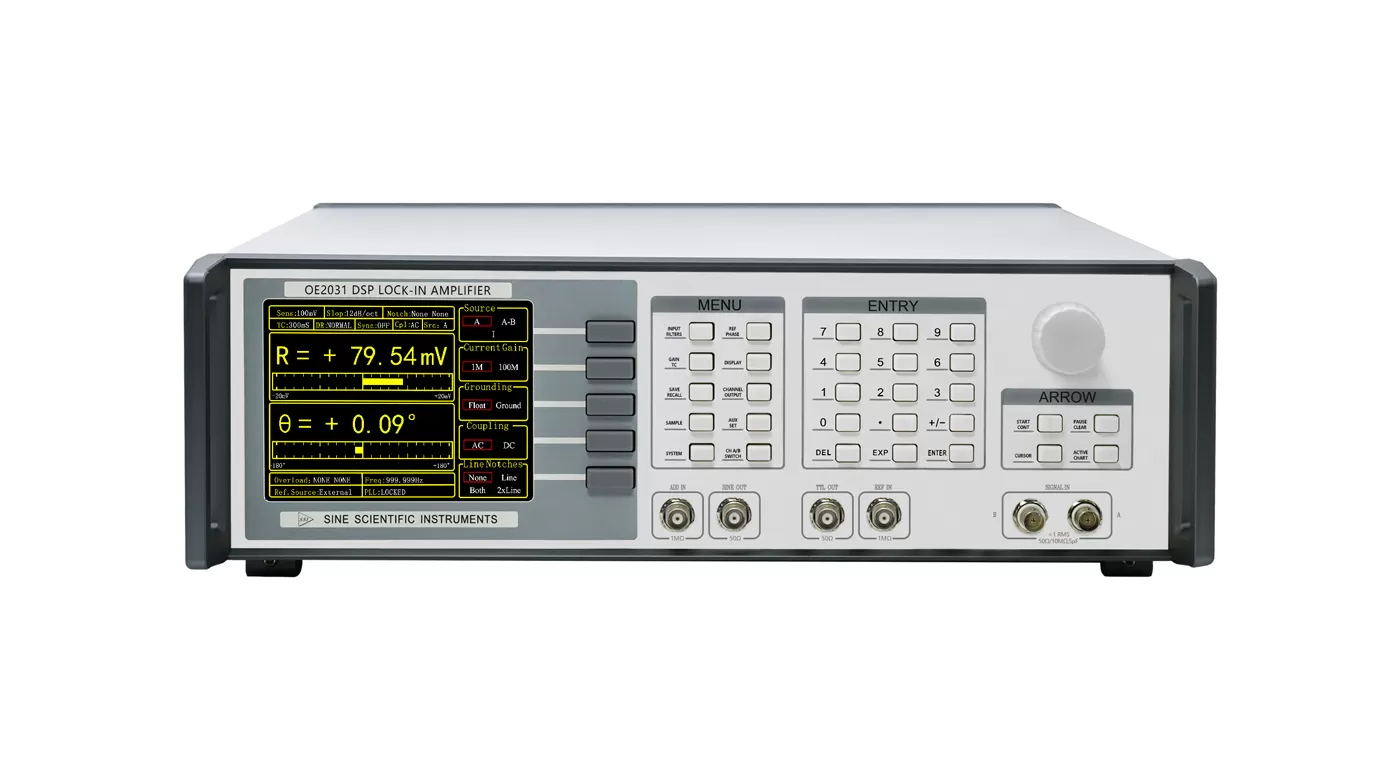
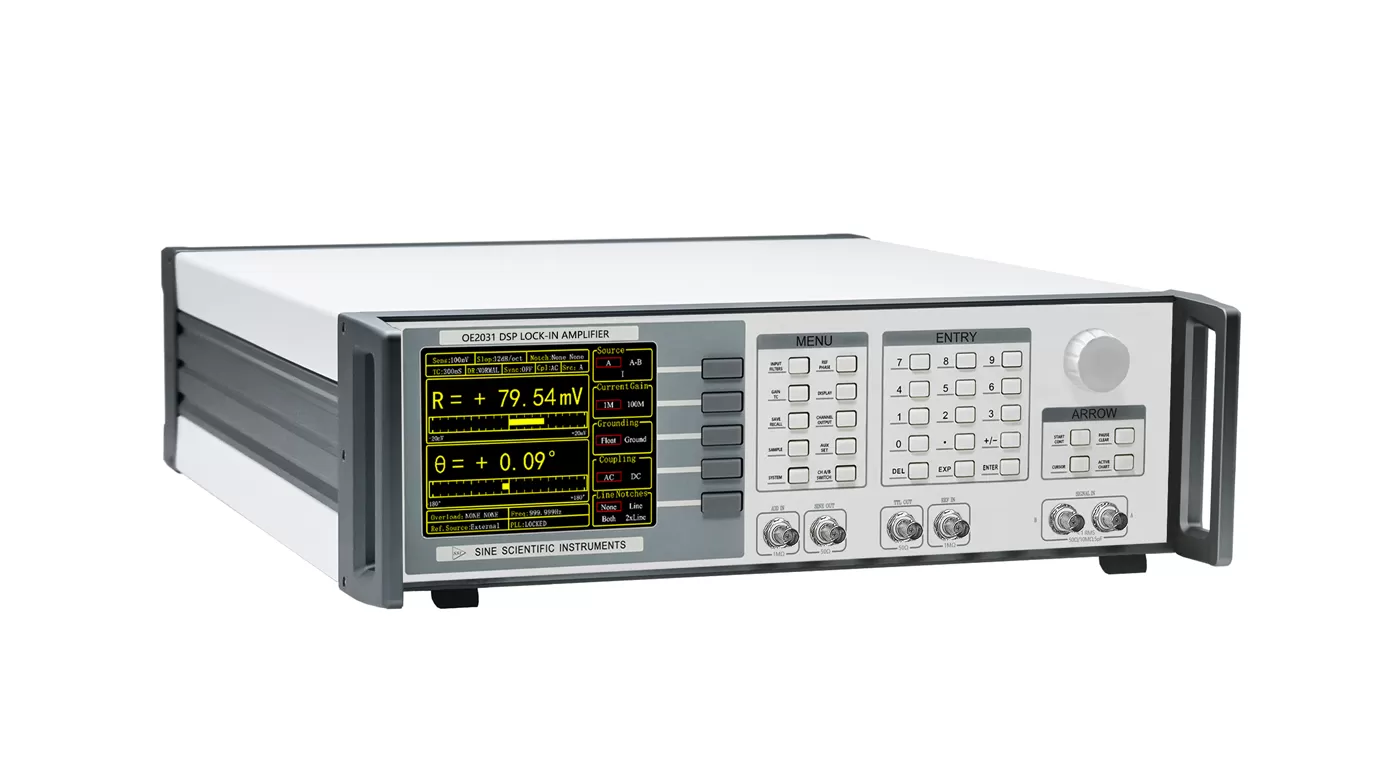
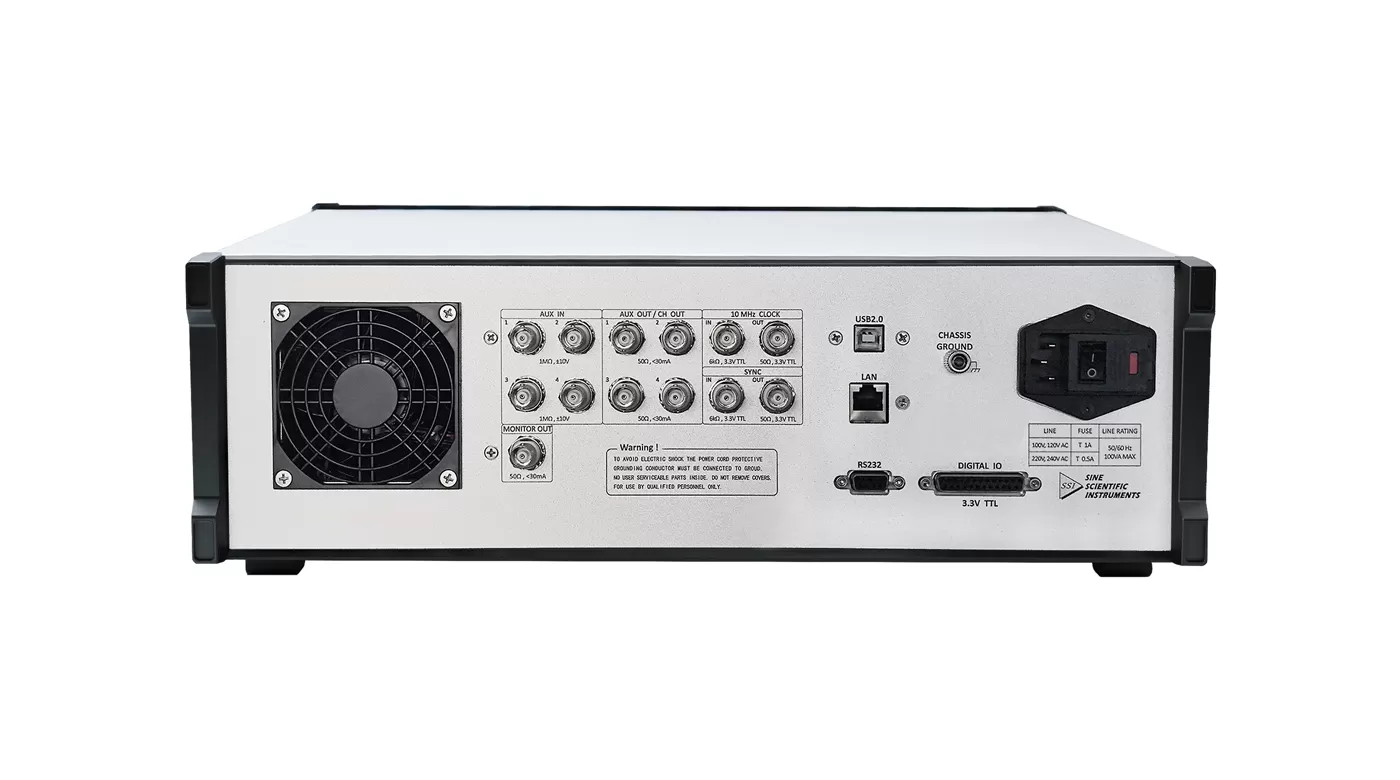
OE2031 detects an input signal in a single-ended mode or a differential voltage mode. With an ultra low-noise pre-amplifier, the input noise is as low as 6 nV/√Hz@100 kHz. The input impedance is 50 Ω or 10 MΩ and the full-scale input voltage sensitivity ranges from 1 nV to 1 V. Besides, designed to eliminate power frequency interference. A programmable gain amplifier is used to adjust the dynamic reserve of the system, so that OE2031 can keep a high dynamic reserve of 120 dB.The high-precision 14-bit ADC has a sampling rate of 250 MSPS, and the excellent anti-aliasing filter in front of the ADC can effectively prevent signal aliasing.
The reference signal can work in external mode or internal mode. In internal mode, a precise and stable internal oscillator generates sine wave as an internal reference that is multiplied by the input signal. This internal signal is without any phase noise. With the digital phase-shifting technique, the phase resolution of the reference signal is 0.001 deg. OE2031 can work at any fixed frequency from 1 mHz to 10 MHz in this mode.In external mode, the reference signal can be a sine wave or a TTL pulse or square wave. The rising or falling edge of the external reference signal triggers the Phase Lock Loop (PLL) to lock the external signal. Based on the frequency of the reference signal, can demodulate multiple harmonics and arbitrarily frequency input signal. The maximum harmonic signal frequency can reach 32,767 times the fundamental frequency, and the maximum harmonic frequency cannot exceed the maximum operating frequency of the instrument by 10 MHz.
The key component of the OE2031 is the digital demodulator. Compared to traditional analog lock-in amplifiers, the OE2031's internal digital demodulator effectively rejects the measurement errors caused by DC drift and offset. In addition, by optimizing the multiplication of the internal coherent signal of the digital demodulator, the calculation error is minimized so that the instrument can accurately detect the input weak signal. Time constants of the output low-pass filter from 10 ns to 4.4 ks can be selected with a choice of 6,12, 18, 24, 10, 36, 42 and 48 dB/oct rolloff. This low-pass digital filter is implemented using a high performance digital filter with a sample rate of 250 MHz. The digitaldemodulation and the low-pass filter used in OE2031 guarantees a high dynamic reserve (>120dB), accurate phase (absolute phase error <1 deg). Moreover, when the frequency of the input signal is lower than 200 Hz, A synchronous filter can be used to eliminate the harmonic influence of the reference signal, ensuring that OE2031 can detect a lowfrequency signal quickly and effectively.
The internal oscillator of OE2031 generates a low distortion (–80 dBc) sine reference signal varying from 1 mHz to 10 MHz, which has a high frequency resolution of 1 mHz. The frequency and amplitude of the reference signal can be set by using the front panel of OE2031 or communication interface. When OE2031 is set in the external reference mode, the internal reference signal is phase-locked with the external reference signal.
OE2031 uses a high precision digital-to-analog converter (DAC) to output a sine wave signal at the same frequency as the internal reference signal from 1 mHz to 10 MHz. The amplitude and phase of the output sine wave can be set through the OE2031's display, where the maximum amplitude of the sine wave is 1 Vrms with 1 uVrms accuracy.
OE2031 has a 5.6-inch 640 x 480 color TFT-LCD. The measurement results of OE2031, such as X, Y, R, and θ, are shown in numerical form and bar graph on the display.In X-Y chart, OE2031 shows the trend of measurement results over time, and check the value by using knob control cursor.
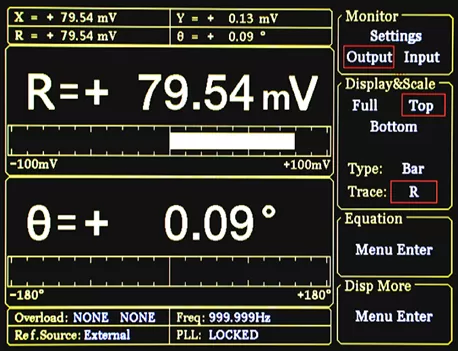
The parameters are convenient to be adjusted by the soft keys besides the display and the numeric keypad on the front panel, such as the internal oscillator frequency and the SINE OUT amplitude.
OE2031 can automatically adjust itself into different optimal operating modes for different input signals, such as Auto Gain mode, Auto Reserve mode and Auto Phase mode. This function makes it easier for users to measure signals more efficiently.
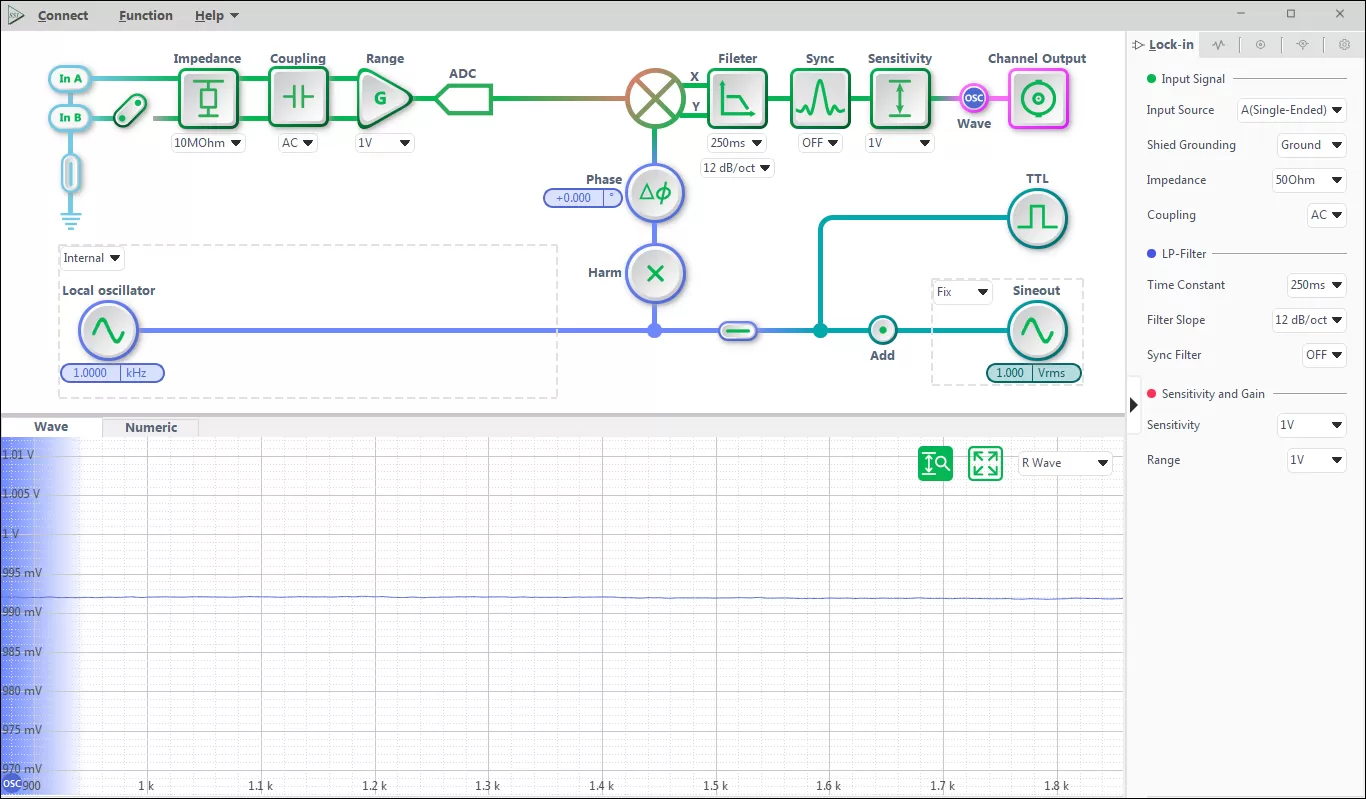
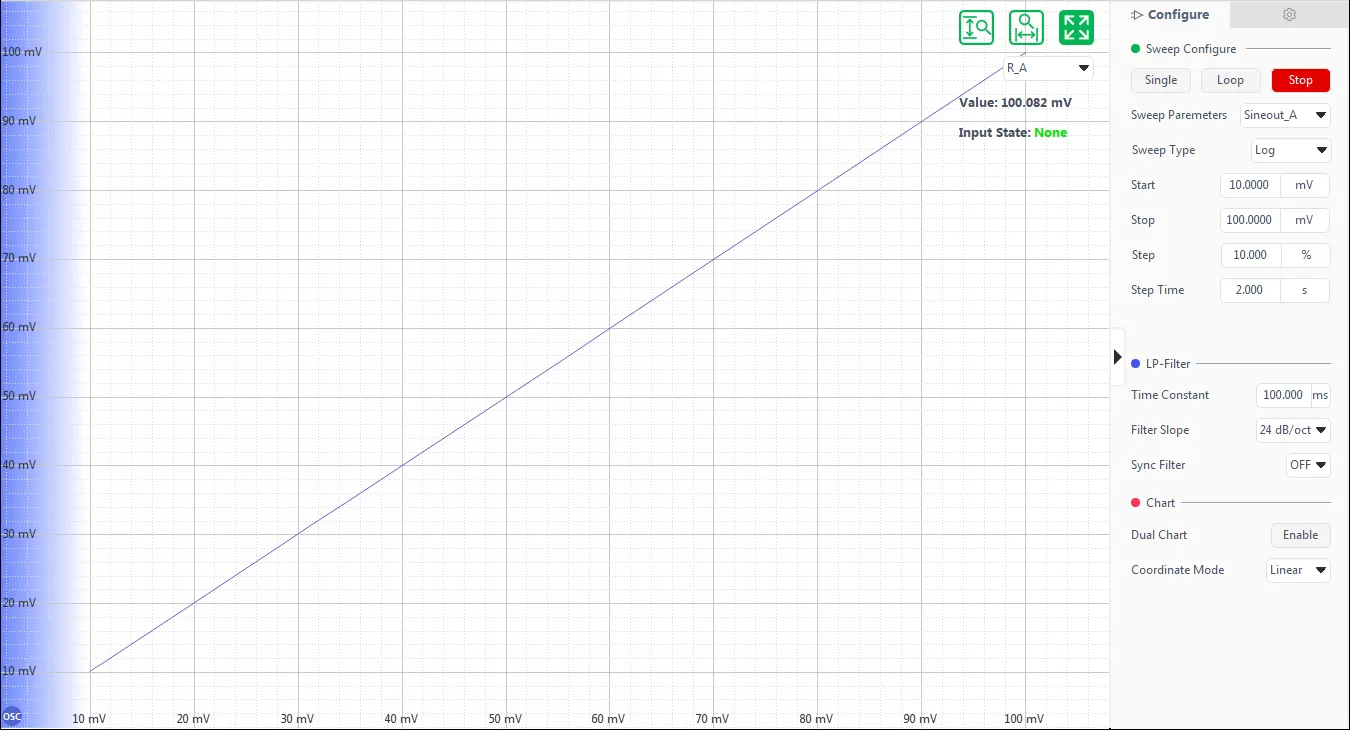
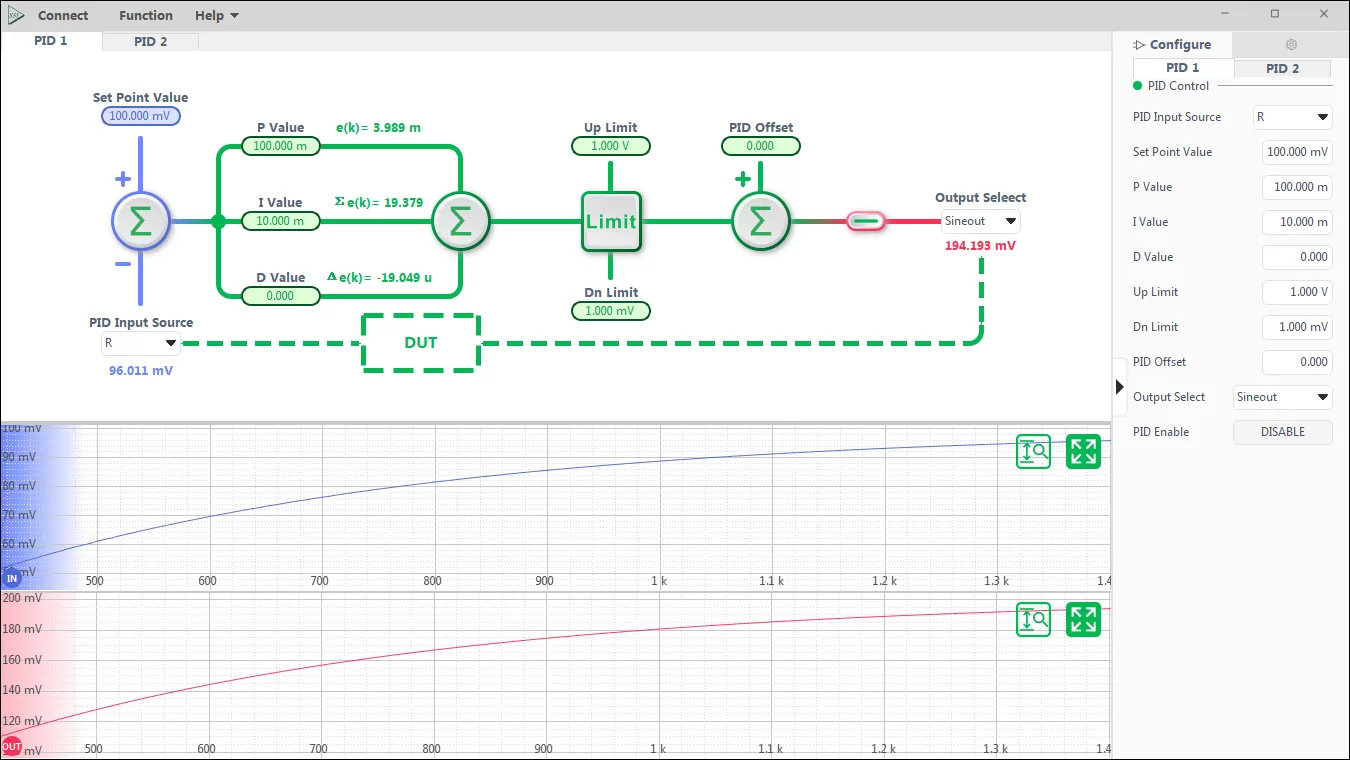
The OE2031 has three interfaces, RS232, USB2.0 and Ethernet, which can be used to set up all the functions of the instrument, ensuring that the user can effectively use all the test functions of the OE2031 on the control computer, including setting up the reasonable control parameters of the instrument and reading the data measured by the instrument. At the same time, in order to make it more convenient for the user to use the various functions, the instrument is equipped with a corresponding LabVIEW programme, which can read and save the measured data in real time. This makes the OE2031 easy to use in complex scientific experiments.
| Voltage Input Mode | Single-ended or Differential |
| Full-scale Sensitivity | 1 nV to 2 V |
| Impedance | 50 Ω // 10 pF or 10 MΩ // 10 pF, AC or DC coupled |
| C.M.R.R | >80 dB(<100 kHz) |
| >70 dB(@1 MHz) | |
| Dynamic Reserve | >120 dB |
| Gain Accuracy | 0.5% typ.(<1MHz), 3% max |
| Voltage Noise | 3.5 nV/√Hz @ 100 kHz |
| 3 nV/Hz@1 MHz | |
| Gounding | BNC (IN+, IN-) shield can be grounded or floated via 1 kΩ to ground |
| Input | |
| Frequency Range | DC- 10 MHz |
| Reference Input | TTL or Sine |
| Input Impedance | 50 Ω // 10 pF or 1 MΩ // 10 pF |
| Phase | |
| Resolution | 1udeg |
| Absolute Phase Error | 1 deg typ.(<1MHz), 5 deg max |
| Drift | <200ppm/℃ |
| Harmonic Detection | 1~10000 (nF < 10 MHz) |
| Acquisition Time | |
| Internal Ref. | Instantaneous acquisition |
| External Ref. | 100 cycles + 5 ms |
| Number | 6 |
| Bit Width | 64 bits |
| Stability | |
| Digital Outputs | no zero drift on all setting |
| Display | no zero drift on all setting |
| Analog Outputs | < 200 ppm/℃ |
| Time Constants | 100 ns to 3 ks (6,12,18,24,30,36, 42,48 dB/oct rolloff) |
| Synchronous Filters | Effective below 1MHz |
| Number | 2 |
| Accuracy | 0.3 ppm |
| Temperature Stability | 0.5 ppm/℃ |
| Phase Noise | -145 dBc/Hz (@1kHz) |
| Frequency | |
| Range | DC- 10 MHz |
| Accuracy | 2 ppm + 1 µHz |
| Distortion | -75 dBFS (f=100 kHz), |
| -60 dBFS (f=1 MHz) | |
| Output | |
| Amplitude | 1 μV to 2 Vrms |
| Accuracy | 0.5% typ.(f<1 MHz), 3%max |
| Stability | < 200 ppm/℃ |
| Drive Capability | ±70 mA max |
| Impedance | 50Ω |
| TTL Sync Output | 3.3V TTL/CMOS level |
| Add In Interface | -10V to 10V voltage signals |
| AUX Inputs | |
| Function | 4 Channel Inputs |
| Voltage | ±10 V full scale, 0.3 mV resolution |
| Impedance | 1 MΩ |
| AUX Outputs | |
| Function | 4 Channel Outputs |
| Voltage | ±10 V full scale, 0.3 mV resolution |
| Drive Current | ± 30 mA max |
| Screen | 5.6 inch 640×480 TFT |
| Screen Format | Dual-column animated chart or full data display chart |
| Display Quantities | X,Y,R,θ values can be displayed for each channel |
| Display Types | Numerical display chart,Bar chart |
| USB2.0 | USB2.0 high-speed interface |
| RS-232(DB-9) | DB-9 female interface |
| 1000Mbps Enthernet | 1GbE interface |
| Power Requirements | |
| Voltage | 100-240 VAC(optional) |
| Frequency | 50/60 Hz |
| Power | 50 W typ., 70W max |
| PSRR | 70dB@1MHz |
| Weight | 8 KG |
| Dimensions | |
| Width | 448 mm |
| Depth | |
| With Handle | 513 mm |
| Without Handle | 470 mm |
| Height | |
| With Feet | 148 mm |
| Without Feet | 133 mm |
| Scanning Microscope | AFM, STM, SPM |
| Materials Science | Carrier Mobility, Carrier Density, Hall Effect, Ultrasonic Materials |
| Transport Measurement | Conductivity Measurement, Impedance Measurement |
| Noise Represents | Noise Density, Cross-Correlation Measurement |
| Optical Experiment | Spectral Analysis, Spectral Measurement, THz Measurement, TDLAS |
| Sensor Measuring | Gyroscope, Photoelectric Sensor, Resonator, Accelerometer |
| Magnetic Sensor | SQUIDs, NV Color Center, Atomic Magnetometer, VSM |
| Biomedical | Microfluidic |
| File name | Explain | Size | Version number | Download |
| OE2031 Introduction Document | Product Introduction Document of OE2031 Lock-in Amplifier. | 2255kb | v251126 |
Download
|
| OE2031 User Manual | Operating Manual for OE2031 Lock-in Amplifier. | 13666kb | v230626 |
Download
|
| Control Software Driver | This LabVIEW firmware needs to be installed first before the control software of each platform can be used. | 368275kb | v2011 |
Download
|
| Serial Port Driver | Windows7 and 8 users need to install this driver before using USB serial ports and RS232 serial ports. | 4316kb | v2.12.26 |
Download
|
| Serial Port Debugging Assistant | Serial port debugging assistant, facilitating the debugging of instruments. | 486kb | v3.8.3 |
Download
|
| USB_Driver for Win7/8 | Users of Windows 7 and 8 need to install the USB2.0 driver separately. | 24820kb | v1.5.0 |
Download
|